 FlightWifi
Explainers
Can You Actually Work on Plane Wi-Fi? What Latency Decides
Video calls, VPNs, cloud docs and SSH at 35,000 feet: why the orbit above your plane matters more than the speed number, and which airlines ban calls even on fast Wi-Fi.

The question every remote worker asks before a long flight is the one airline marketing never answers: can I actually work on this Wi-Fi, or will I lose the day?
The honest answer has almost nothing to do with megabits. It hangs on one number the Wi-Fi page never prints: how far away the satellite is.
Latency decides, not speed
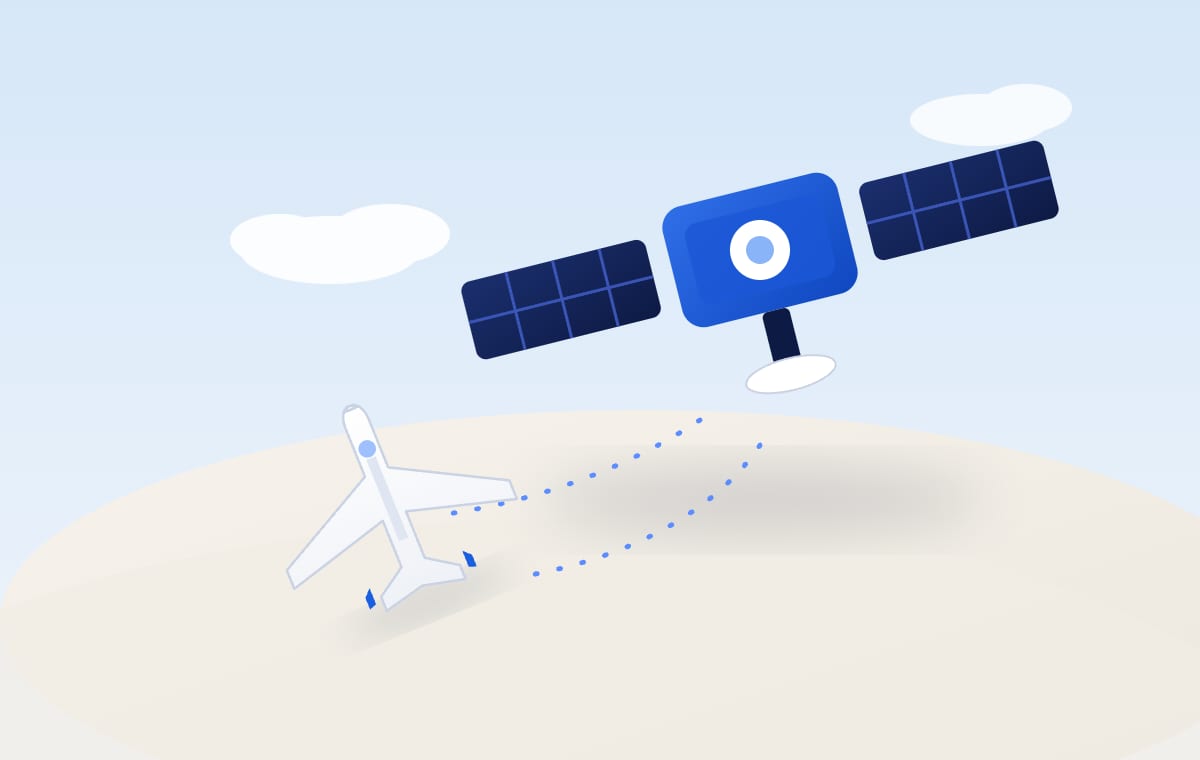
Every satellite Wi-Fi system on earth belongs to one of three orbits. Traditional systems use geostationary satellites parked about 36,000 km up; the round trip alone adds roughly 600 ms before any congestion. Medium-orbit systems like SES's O3b mPOWER sit around 8,000 km and land near 120 to 150 ms. Low-orbit constellations like Starlink fly at about 550 km and deliver 20 to 50 ms, which is home-broadband territory.
Bandwidth tells you how fast a page loads. Latency tells you whether a live conversation is possible. A high-orbit link can stream a movie beautifully and still make a video call unusable, because half a second of lag breaks the rhythm of human speech.
What works on which system
On a low-orbit link, essentially everything works: video calls, screen shares, cloud documents, SSH sessions, pushing code. On a high-orbit link, asynchronous work is fine: email queues and sends, documents save, Slack messages arrive with a beat of delay. What fails is anything interactive in real time. Calls stutter and talk over themselves, remote desktops feel like wading, and every keystroke of an SSH session takes a detectable round trip.
A VPN deserves its own line: it usually connects on either system, but on high orbit every handshake pays the 600 ms toll, so corporate VPNs feel dramatically slower than the raw connection. A few airlines also exclude VPN traffic from promotional free tiers, so if the VPN is mandatory for your work, check the fine print of the free package.
The airlines that ban calls on fast Wi-Fi
Here is the wrinkle the latency table misses: some airlines have fast Wi-Fi and prohibit calls anyway, as cabin policy rather than a technical limit. Delta, United, WestJet, SAS and Air New Zealand state it outright, and several more are reported to. Virgin Atlantic permits voice calls but not video. British Airways, Qatar Airways and Aer Lingus let calls happen. The FlightWifi verdict chips carry this distinction: fast Wi-Fi with a call ban reads "Fast, but no calls" instead of "Video calls work".
Same airline, different day, different office
The final trap is fleet variance. On a mid-retrofit airline, Tuesday's flight has a low-orbit system and Wednesday's identical flight number has the 2015 one, because airlines convert one aircraft at a time. United is around 29% converted; Emirates has 36 widebodies done of 232. The plane decides your workday, not the airline logo, which is why per-aircraft verdicts exist at all.
How to plan a working flight
Treat it like choosing a desk. Check the airline's page for its per-aircraft verdict, or let the extension show it inline while you search. If the verdict is "Varies by aircraft", assume the slow case and be pleasantly surprised. Download the heavy files before boarding, queue the async work for high-orbit legs, and save the calls for flights where the verdict actually says calls work.
The airlines can't tell you which plane you'll get. The data can tell you what each plane carries. Plan against the second thing.
Frequently asked questions
Can you make video calls on plane Wi-Fi?
Only on low-orbit systems like Starlink, where latency is 20 to 50 ms, and only on airlines that permit calls. Traditional high-orbit Wi-Fi adds roughly 600 ms of lag, which breaks live calls even when bandwidth is fine, and several airlines ban calls as cabin policy regardless.
Does a VPN work on airplane Wi-Fi?
Usually yes on both orbit classes, but on high-orbit systems every round trip pays about 600 ms, so VPN-tunneled work feels much slower. A few airlines exclude VPN traffic from free promotional tiers, so check the package terms if a VPN is mandatory for you.
Is plane Wi-Fi fast enough for Zoom?
On Starlink-equipped aircraft, yes, when the airline permits calls. On geostationary-satellite Wi-Fi, no: the lag makes participants talk over each other even when the connection streams video smoothly.
Why do some airlines ban calls even with fast Wi-Fi?
Cabin experience policy: airlines like Delta, United, WestJet, SAS and Air New Zealand prohibit voice and video calls so passengers are not stuck next to an hour-long meeting. The restriction is enforced as policy, not by the technology.

Know before you book.
FlightWifi shows these verdicts inline on Google Flights, Skyscanner and Rift, matched to the exact aircraft on your flight.
The extension itself runs in Chrome on a computer. What it does.